History Trail


-
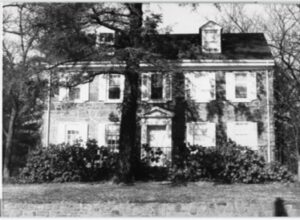
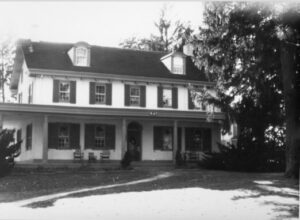
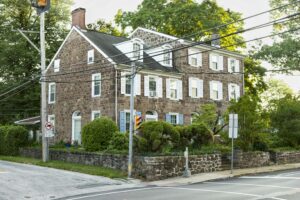
Andrew Todd House/Isenberg Hall
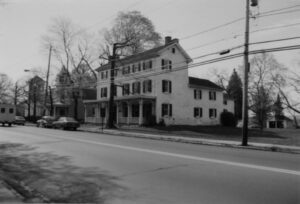
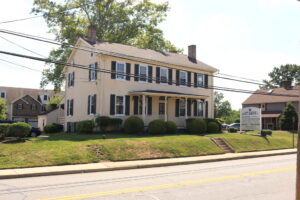
801 E. Main StreetOwned by Andrew Todd, who in 1832 donated land on which a one-room stone schoolhouse—known as Todd’s school School—was built (not extant) in place of an earlier log schoolhouse. From 1844 to 1874, it was the Freeland Public School. One of the oldest houses in Collegeville, this dwelling was later owned by Dr. James Hamer. It is now known as Isenberg Hall, after Rev. J.M.S. Isenberg, who graduated from Ursinus in 1893 and was vice-president of the college until 1930. A nearby carved stone mile marker notes the distance as 24 miles to Philadelphia and 28 miles to Reading. Private
-
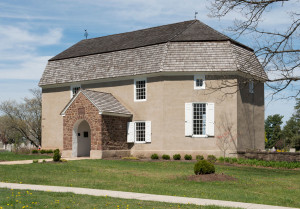
Augustus Lutheran Church
717 W. Main StreetBuilt between 1743 and 1745, Augustus Lutheran Church is known as the shrine of American Lutheranism. It was designated as a National Historic Landmark in 1967. Henry Melchior Muhlenberg served as its pastor from 1742 until his death in 1787. The wrought-iron weathervanes atop the roof are exact replicas of the originals. During the Revolutionary War, the church was used by the Continental Army as a field hospital. Many members of the Muhlenberg family and other prominent local residents, including Governor Francis Shunk, are buried in the graveyard. Tours are available by appointment. Open to the public.
-
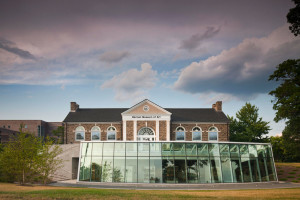
Berman Museum of Art
601 E. Main StreetOpened in 1923 as the Alumni Memorial Library to commemorate the 271 Ursinus students and alumni who served in World War I, this elegant stone building is now home to the Philip and Muriel Berman Museum of Art. The museum hosts changing exhibitions and educational programs throughout the year. Open to the public
-
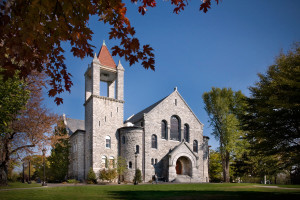
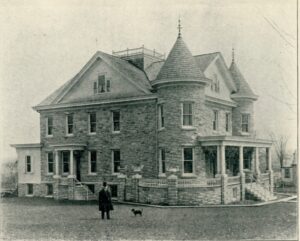
Bomberger Hall
601 E. Main StreetDesigned by architect Frank R. Watson of Philadelphia, the cornerstone of Bomberger Memorial Hall was laid on June 25, 1891. Built in the Romanesque style, much of the stone was quarried nearby in King of Prussia. Opened in 1892, the building provided the college with modern classrooms, offices, a library, and a chapel. The auditorium houses the Heefner Memorial Organ, a three-manual 62-rank organ dedicated in 1986. Open to the public for special events
-
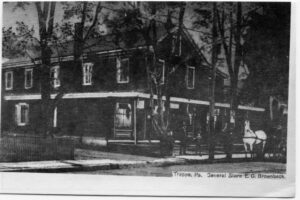
Brownback Store
538 W. Main StreetBorn and educated in Trappe, E. G. Brownback married Mary Beaver in 1895. He took over his father-in-law John Beaver’s mercantile business and operated it in this building. Private
-
Clamer Hall
409 E. Main StreetBuilt by Francis J. Clamer, a German immigrant and metallurgist, in 1903, Clamer Hall was given to Ursinus by Dr. Guillam H. Clamer in 1953. Private
-
Collegeville Economic Development Corporation
476 E. Main StreetA nonprofit organization, the Collegeville Economic Development Corporation (CEDC) is striving to make Collegeville a great place to live and do business. Many special events and programs are organized by the CEDC throughout the year. Open to the public
-
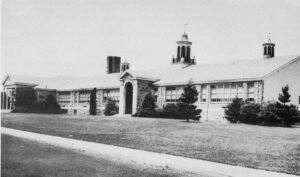
Collegeville-Trappe High School
29 E. First Avenue.A groundbreaking ceremony was held on November 11, 1938, for a new Collegeville-Trappe High School to be built under the auspices of the federal government’s Public Works Administration. The above postcard depicts the school as built; in 1953 an addition was built on the right side to match the colonial revival style of the original building. Howard B. Keyser, a 1905 graduate of the Collegeville High School and 1910 Ursinus graduate, was the supervising principal of the newly consolidated school district. Most of the land for the new school was provided by Ursinus College in a bargain sale in which the former Frederick Muhlenberg property, at 151 W. Main Street, was subdivided.
-
Dewees Tavern
301 W. Main StreetBuilt in several sections from the mid-1700s to early 1800s, the east end of this building was the home of Andrew Miller, a joiner and bellows maker. In 1827 it was acquired by Dr. Jacob Dewees; his mother Mary Catharine Dewees ran it as a tavern and boarding house until 1855. The building also served as a polling place and stagecoach stop. It is now the headquarters of Historic Trappe, a museum, research library, and changing exhibitions. Open to the public
-
Duryea Hall
612 E. Main StreetPurchased in 1937 from A. D. Fetterolf by the Ursinus Women’s Club, Duryea Hall was named ten years later in honor of Rhea Duryea Johnson, who graduated from Ursinus in 1908 and later became the college’s first female board member. Private
-
Eger Gateway
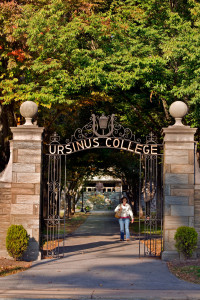
601 E. Main StreetErected at the main entrance to Ursinus in 1925 through the generosity of George P. Eger, this iron and stone gateway has inset tablets telling the history of education on the campus since 1832. Open to the public
-
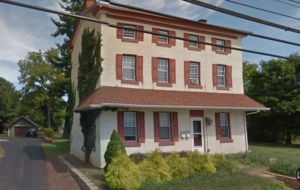
Fetterolf House
554 E. Main StreetThis three-story stone farmhouse was built during the 1800s by William Tennent Todd, a spinning wheel maker; it was the first residence of Rev. John H. A. Bomberger, founding president of Ursinus College. From 1867 to 1872, it was the home of Captain Henry H. Fetterolf, who served in the Civil War. The house was later donated to the college by Henry’s daughter, Harriet “Hattie” Fetterolf. Private
-
Fircroft
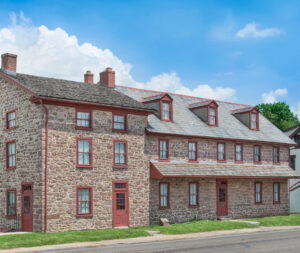
930 E. Main StreetBuilt about 1835 for Rev. Abraham Hunsicker, a Mennonite bishop and the founder of Freeland Seminary, this dwelling contains elements of an earlier stone house built for Christian Schrack, son of Trappe’s founder and a tanner by trade. Private
-
George Hagey House
417 W. Main StreetBuilt about 1830, this house was the residence of George Hagey, a renowned clockmaker, from 1832 to 1844. A native of nearby Lower Salford Township, George Hagey was the second generation of his family to make clocks. Private
-
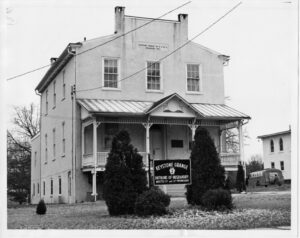
Grange Hall
192 W. Main StreetBuilt in 1849 by the Providence Masonic Lodge, this building was sold in 1865 to Warren Lodge. In 1913, it became the headquarters of Keystone Grange #2, organized in 1873 and the second oldest grange in Pennsylvania. Monthly meetings are held on the third Wednesday at 7 p.m. Open to the public
-
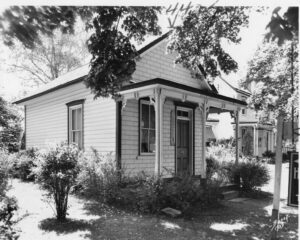
Henry Kratz House
378 W. Main StreetBuilt for Henry Kratz in the mid-1800s, this house is flanked by a smaller building to the east that once served as a post office. Private
-
Henry Muhlenberg House
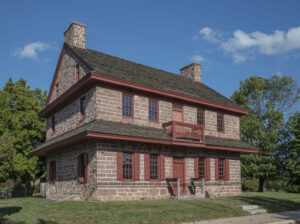
201 W. Main StreetBuilt about 1750 for Jacob Schrack Jr., a blacksmith, this large stone house was purchased by Henry and Anna Maria Muhlenberg in 1776. The Muhlenbergs added a rear wing, now missing, as a summer kitchen complete with a bake oven. Restored to its c. 1776 appearance and listed on the National Register of Historic Places.
-
Henry Prizer House
360 W. Main StreetBuilt in the mid-1700s and used as a tavern known as the Duke of Cumberland, this building was acquired in 1829 by schoolmaster Henry Prizer, remodeled, and used as a school prior to the construction of Washington Hall about 1854 (see 550 W. Main). A detached stone bake house stands behind the main building. Private
-
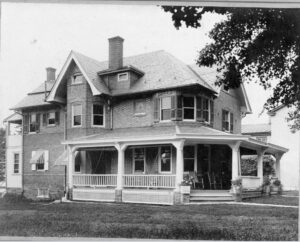
Hobson Hall
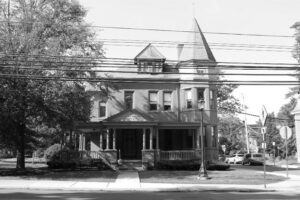
568 E. Main StreetBuilt in the late 1800s as a private residence, Hobson Hall’s three-story tower, asymmetrical façade, and multiple porches exemplify the Queen Anne revival style that was popular in America from about 1880 to 1910. It was acquired by Ursinus from Edward and Mabel (Hobson) Fretz in 1944. Private
-
John Beaver House
532 W. Main StreetHome of John K. Beaver, a tailor by trade, who later established the Beaver & Shellenberger mercantile firm, which operated in Skippack and later Trappe. In 1895, the Trappe store at 538 W. Main was taken over by Beaver’s son-in-law, E. G. Brownback. Private
-
Joseph Royer House
702 and 704 W. Main StreetThe three-story stone house was built for Judge Joseph Royer and his family in the early 1800s; the two-story wing served as a general store and post office. Private